Deterministic Code Change
Authorization System
Replaces opinion-based code review with execution-backed authorization.
Built for CI/CD environments where unsafe merges carry real risk.
Every code change is either proven correct, proven incorrect, or explicitly unverifiable.
No code change is trusted unless its behavior is reproducibly verified.
- ALLOW→behavior verified
- BLOCK→divergence detected
- UNVERIFIABLE→proof unavailable
End-to-end execution showing ALLOW, BLOCK, and UNVERIFIABLE decisions.
System in One Page
Authorize code changes using execution proof, not confidence.
Core Rule
No change is trusted unless its behavior is reproducibly verified.
5-Step System Flow
System Guarantees
- Same input + same environment → same decision
- No execution → no approval
- No forced decisions under uncertainty
- Every decision is reproducible and auditable
Where It Fits
Product Strategy Lens
Positioning for high-assurance enterprise scaling.
Target Customer
Regulated engineering teams, high-assurance networks, and security-critical backend systems.
Buyer
VP Engineering, CISO, or Platform Leaders seeking rigid compliance architectures.
Core Value
Execution-backed authorization and mathematically auditable deployment boundaries.
Adoption Path
Phased rollout: Shadow mode logging → Soft UI enforcement → Hard authorization gate.
System Architecture
Core topographical constraints and transactional workflows.
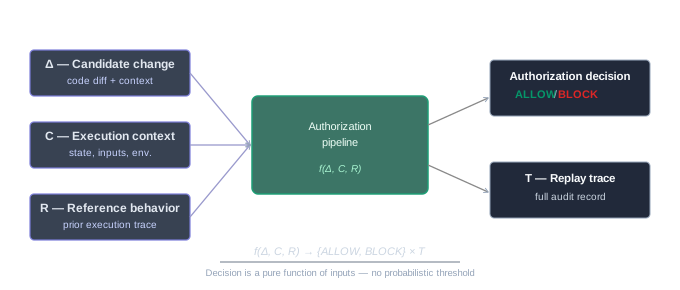
System Model
Boundary interception diagram outlining execution isolation.
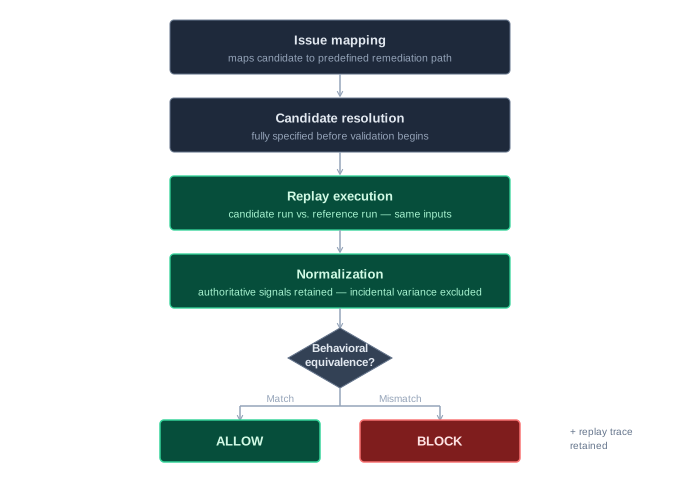
Execution Workflow
Execution isolation phase map from PR to authorization.
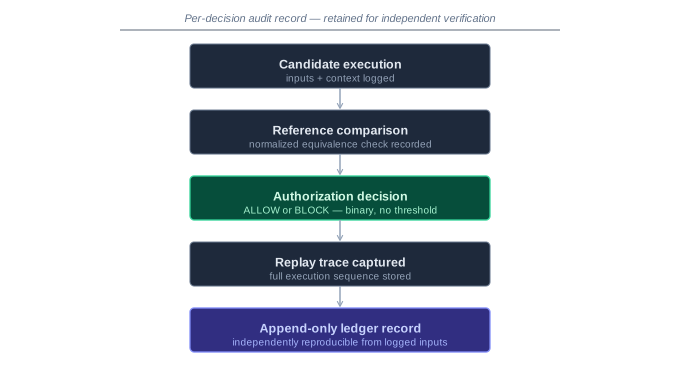
Audit Trail
Immutable transaction log format preserving reproducible evidence.
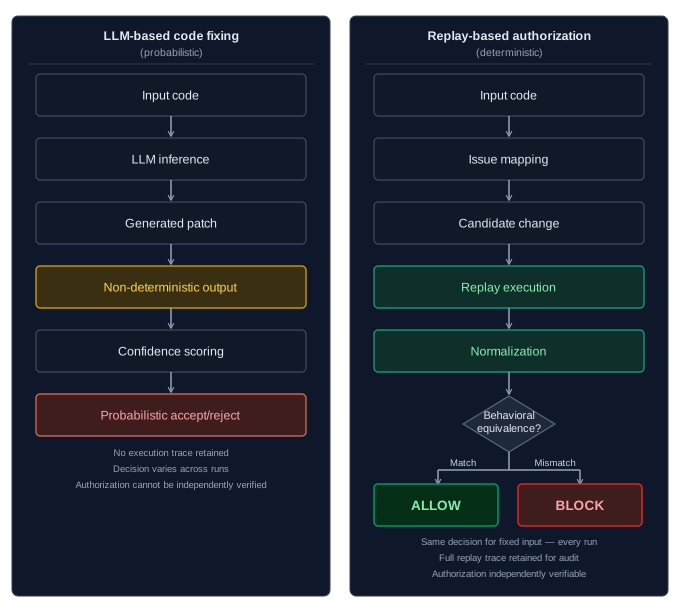
Boundary Comparison
Heuristic vs Deterministic authorization path flow.
Controlled Evaluation / Decision Boundary Validation
Goal was not approval rate. Goal was decision integrity.
Safe changesValid deterministic patches verified against identical baseline execution without side-effect disruption.
Behavioral divergencePatches exposing unintended state mutations, logic regressions, or diverging network payloads.
Non-deterministic scenariosHigh entropy paths, race conditions, or uncaptured state modifications preventing execution equivalence.
The system surfaces uncertainty instead of masking it.
Where This Intentionally Stops
- ■Non-deterministic execution→ UNVERIFIABLE
- ■Time-dependent logic→ requires controlled inputs
- ■Distributed systems with uncontrolled state→ weak fit
- ■UI / subjective rendering→ not supported
Implementation Complexity
Defining a comparison surface
Structuring the deterministic comparison boundary without hiding real logic differences.
Avoiding over-normalization
Massaging state variables intelligently without masking destructive behavioral changes.
Capturing complete execution state
Reliably serializing context, network footprints, and memory footprints cleanly.
Handling non-determinism
Recognizing unresolvable entropy without forcing automated decisions.